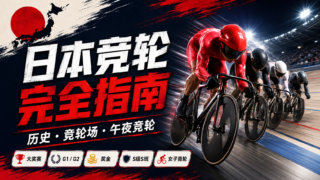
Complete Guide to Japanese Keirin
Japanese keirin is a professional bicycle track racing sport that originated in Japan. Riders compete on dedicated racing bicycles, and the outcome is shaped not only by speed, but also by positioning, tactics, timing, and the movement of other riders.
At first glance, Japanese keirin may look similar to Korean keirin. However, Japanese keirin has several distinctive features, including line tactics, a wide range of race grades, many velodromes across the country, and late-night online racing known as Midnight Keirin.
This guide explains the basics of Japanese keirin for readers who are new to the sport. It covers the history of Japanese keirin, velodromes, race characteristics, racing schedules, major events, prize money, rider classes, wagering tickets, S-Class S Group riders, Girls Keirin, and the relationship between Japanese and Korean keirin.
History of Japanese Keirin
Japanese keirin began in 1948. After World War II, Japan developed new sports and public racing systems, and keirin was created as a professional bicycle racing sport within that context.
The first Japanese keirin race was held at Kokura Velodrome in Kitakyushu, Fukuoka Prefecture. Kokura Velodrome is widely known as the birthplace of Japanese keirin and remains an important location in the history of the sport.
In its early years, Japanese keirin was closer to a simple bicycle race. Over time, however, riding styles, line tactics, rider classes, and major race structures were developed. As a result, modern Japanese keirin has become a sport that combines speed, strategy, positioning, and psychological competition.
Japanese keirin is also operated as a public racing sport. A portion of race revenue is used for public-interest purposes. This means that Japanese keirin is not only a form of sports entertainment, but also part of a broader public and industrial support system.
The track cycling event known as Keirin has also been adopted as an Olympic discipline, helping the Japanese-born format become known internationally.
Japanese Velodromes
Japanese keirin is held at velodromes across the country. A velodrome is not just a racing venue. It is also a stage where regional racing styles, track characteristics, and rider tactics become visible.
Velodromes in Japan are spread across many regions, including Hokkaido and Tohoku, Kanto, South Kanto, Chubu, Kinki, Chugoku, Shikoku, and Kyushu. As a result, races are often held at multiple venues on the same day.
One of the most important things to understand about Japanese velodromes is the length and structure of the track. Japanese keirin tracks are commonly 333 meters, 400 meters, or 500 meters in length. The track length affects race development and can change which riding styles are more effective.
| Track Type | Main Characteristics |
|---|---|
| 333-meter track | A shorter lap creates fast race development and rewards quick acceleration |
| 400-meter track | The most common type in Japanese keirin, often producing balanced race patterns |
| 500-meter track | A longer lap places more emphasis on stamina and sustained attacks |
Each velodrome has its own final straight, corner angles, wind conditions, and track surface characteristics. Because of this, the same rider may perform very well at one velodrome but struggle at another.
Experienced Japanese keirin fans do not look only at a rider’s recent results. They also consider whether the rider is suited to a particular velodrome, track shape, and race pattern. This is one of the key points that makes Japanese keirin interesting to analyze.
Compared with Korean keirin, Japanese keirin tends to show stronger differences from venue to venue. To understand a Japanese keirin race more deeply, it is helpful to consider both the rider’s ability and the characteristics of the velodrome.
Key Features of Japanese Keirin Races
The biggest feature of Japanese keirin is that it is not simply a contest of speed. Positioning and tactics have a major impact on the result. Even in the same bicycle race, the outcome can change depending on who moves first, who follows from behind, and when each rider starts their final sprint.
One of the most important concepts in Japanese keirin is the line. A line is a temporary tactical group formed by several riders. Typically, one rider takes the front and cuts through the wind, while another rider follows closely behind and waits for a chance to make a decisive move near the finish.
| Riding Style | Explanation |
|---|---|
| Front-runner | A rider who moves early, raises the pace, and leads the race |
| Marker | A rider who follows another rider closely and tries to keep a strong position |
| Late finisher | A rider who is strong at overtaking near the final straight |
| Outside attacker | A rider who accelerates from the outside to pass the leading line |
For people familiar with Korean keirin, line tactics are often the biggest difference in Japanese keirin. In Japan, it is not enough to look only at the ability of individual riders. It is also important to understand who is following whom, which line moves first, and how different lines compete against each other.
In the early part of the race, riders focus on securing position. Instead of immediately sprinting at full speed, they try to place themselves where they can make the most effective move later. In the middle stage, the lines begin to move, and in the final stage, the race becomes a full-speed battle.
In the closing section, riders sprint at maximum effort. Some riders try to hold on from the front, others come from behind, and some make a wide move around the outside. Because of these different patterns, the result of a Japanese keirin race can remain uncertain until the final straight.
Another important feature is the balance between physical racing and strict rules. Riders may fight strongly for position, but dangerous movement, excessive contact, or unsafe blocking can result in a penalty. Riders must therefore make precise decisions while racing aggressively.
Japanese keirin is not simply a sport where the fastest rider always wins. Speed, tactics, line formation, timing, and positioning all have to come together. Understanding this makes the race development much more interesting to follow.
Race Schedules and Midnight Keirin
Japanese keirin is held almost every day in several regions of Japan. It is common for races to take place at multiple velodromes on the same day. Fans usually check the date, time, venue, riders, and race grade before following a race.
Japanese keirin race times can be broadly divided into morning, daytime, night, and late-night racing. Each time slot has a slightly different audience and viewing style.
| Category | Main Characteristics |
|---|---|
| Morning Keirin | Races held in the morning |
| Daytime Keirin | Standard races held during the day |
| Night Keirin | Races held from evening into the night |
| Midnight Keirin | Late-night races mainly designed for online viewing and wagering |
One format that is especially easy to follow from overseas is Midnight Keirin. Midnight Keirin usually starts around 9 p.m. and continues until after 11 p.m. Japan and Korea are in the same time zone, so Korean viewers can follow these races live without any time difference.
Unlike standard daytime racing, Midnight Keirin is centered on online viewing and online wagering. In many cases, it is held without general spectators at the venue. This makes it well suited for fans who watch races on a smartphone or computer.
Midnight Keirin is also compact and easy to follow. Since the overall race program is relatively short, beginners can watch multiple races in a focused period without spending the entire day following the event.
For readers familiar with Korean keirin, Midnight Keirin can be a good entry point into Japanese keirin. The time slot is convenient, information is easy to check online, and several races can be watched in a short period.
Grand Prix, G1, and G2 Races
Japanese keirin races are divided into grades based on their importance and the level of riders taking part. The highest level is the Grand Prix, followed by G1, G2, G3, F1, and F2.
The higher the grade, the stronger the field and the larger the prize money. The Grand Prix and G1 races are the most prestigious stages in Japanese keirin.
| Grade | Explanation |
|---|---|
| Grand Prix | The highest-level special race in Japanese keirin |
| G1 | Major championship-level races that define the season |
| G2 | Important races just below G1 level |
| G3 | Major commemorative races held at individual velodromes |
| F1 | Standard events often featuring S-Class and A-Class riders |
| F2 | Standard events mainly featuring A-Class, Challenge, and women’s races |
The most symbolic race in Japanese keirin is the KEIRIN Grand Prix. It is held at the end of the year as a one-race showdown featuring the top riders of that season.
The KEIRIN Grand Prix is not simply the final race of the year. It is the stage that determines the leading rider of the season. The winner receives both major prize money and the highest level of prestige in Japanese keirin.
G1 races are also central to the Japanese keirin calendar. Winning a G1 can have a direct impact on qualification for the Grand Prix, making these races extremely important for top riders.
Representative G1 races include the following:
| Race | Main Characteristics |
|---|---|
| All-Japan Selection Keirin | A major G1 race that helps shape the early part of the season |
| Japan Championship Keirin | One of the most traditional and prestigious races in Japanese keirin |
| Takamatsunomiya Memorial Cup Keirin | A major race with a strong East-versus-West character |
| Tomohito Shinno Cup | An important G1 race held in the autumn season |
| All-Star Keirin | A popular G1 race that includes a fan-voting element |
| Keirin Festival | A major G1 race held shortly before the year-end Grand Prix |
G2 races sit just below G1 races. Although they are not at the very top level, they still feature strong fields and can significantly influence the direction of the season.
Representative G2 races include the Kyodo News Service Cup, the Summer Night Festival, and the Young Grand Prix. The Young Grand Prix is especially notable because it features promising young riders who may become future stars of Japanese keirin.
Prize Money in Japanese Keirin
Japanese keirin is a professional sport, and riders earn prize money based on their race results. Prize money varies greatly between standard events and major races, and the higher the race grade, the larger the potential prize.
The largest prize-money stage in Japanese keirin is the year-end KEIRIN Grand Prix. This race brings together top riders who have performed well throughout the year, and its winner receives one of the highest prizes in the sport.
Prize money is not paid only to the winner. It is distributed according to finishing position. In high-grade finals, the difference between first, second, and third place can be large, but finishing near the top still carries major financial and sporting value.
For riders, prize money is not only income. Strong results in major races can improve a rider’s prize-money ranking, which may also affect the race to qualify for the Grand Prix. A single major race win can change the course of an entire season.
A G1 victory is especially meaningful. It brings prize money, prestige, recognition, and a stronger position in the Grand Prix qualification race.
Prize money is also important in Girls Keirin. The Girls Grand Prix is one of the biggest stages for women riders, and the winner is recognized as one of the leading women in Japanese keirin for that year.
Rider Class System
Japanese keirin riders are divided into classes based on results and ability. These classes directly affect the level of races a rider can enter and the strength of the opponents they face.
Men’s keirin riders are broadly divided into S-Class and A-Class. S-Class is the upper level, while A-Class is the level below it.
| Class | Explanation |
|---|---|
| S-Class S Group | A special class for the very top riders in Japanese keirin |
| S-Class 1 Group | Upper-level S-Class riders |
| S-Class 2 Group | Standard S-Class riders |
| A-Class 1 Group | Upper-level A-Class riders |
| A-Class 2 Group | Mid-level A-Class riders |
| A-Class 3 Group | A class that often includes new riders and lower-ranked riders |
The highest class is S-Class S Group. This special class is explained in more detail in the next section.
S-Class 1 Group and S-Class 2 Group also include highly skilled riders. Major races and high-level events are usually centered around S-Class riders. In G1, G2, and G3 races, the tactical and physical strength of S-Class riders becomes especially clear.
A-Class is below S-Class, but it is still very important for understanding Japanese keirin. A-Class riders appear frequently in standard events. This group includes young riders, developing riders, and riders trying to return to S-Class.
A-Class 3 Group is also where many new riders begin. After becoming professional keirin riders, many start in this class and build experience. With strong results, they can move up to A-Class 2 Group, A-Class 1 Group, and eventually S-Class.
Women riders use a different class system. Girls Keirin riders are generally classified as L-Class 1 Group. They compete in a separate race structure and aim for major women’s races such as the Girls Grand Prix.
Understanding rider classes is very important in Japanese keirin. A rider’s class helps show what level they are competing at and what kind of opponents they usually face.
For beginners, it is best to first understand the difference between S-Class and A-Class. After that, learning the difference between S-Class S Group, S-Class 1 Group, and S-Class 2 Group makes major races much easier to follow.
Wagering Tickets and Bet Types
In Japanese keirin, the tickets purchased to predict race results are called wagering tickets. They are similar in concept to bet types in Korean keirin. Fans predict which riders will finish in specific positions or which riders will finish near the top.
Japanese keirin wagering tickets can usually be purchased in units of 100 yen. Tickets are sold at venues and through online platforms. Midnight Keirin, in particular, is strongly connected with online viewing and online wagering.
Representative bet types include the following:
| Bet Type | What to Predict | Main Characteristics |
|---|---|---|
| Trifecta | First, second, and third place in exact order | Difficult, but can produce high payouts |
| Trio | The three riders who finish in the top three, in any order | Easier than the trifecta |
| Exacta | First and second place in exact order | A common basic bet type in Japanese keirin |
| Quinella | The two riders who finish first and second, in any order | Relatively easy to understand |
| Wide | Two selected riders both finish in the top three | Beginner-friendly |
| Frame Exacta | The frame numbers of first and second place in exact order | Based on frame numbers rather than individual riders |
| Frame Quinella | The frame numbers of first and second place in any order | A bet type using frame numbers |
For beginners, Quinella and Wide are often easier to understand. They do not require the exact finishing order, making them more approachable for people new to Japanese keirin.
The Trifecta is one of the most popular bet types. It requires correctly predicting first, second, and third place in exact order, so it is difficult. However, it can also produce higher payouts when the prediction is correct.
When buying wagering tickets in Japanese keirin, it is important not to focus only on the strongest individual rider. Line formation is also crucial. For example, if a strong front-runner leads the race and a late finisher from the same line follows closely behind, both riders may have a good chance of finishing near the top.
Japanese keirin wagering is not based only on luck. Fans analyze riding styles, line formation, velodrome characteristics, and race development. Understanding these elements allows the sport to be enjoyed as a tactical contest as well as a form of wagering.
However, wagering involves money, so it should be approached responsibly. It is best to enjoy Japanese keirin within a reasonable budget and focus on the sporting and analytical aspects of the race.
S-Class S Group in Japanese Keirin
The most special rider class in Japanese keirin is S-Class S Group. This is the highest class in the men’s rider system and is one of the greatest honors for a Japanese keirin rider.
S-Class S Group riders are not fixed permanently. They are selected each year based on performance. Riders who qualify for the Grand Prix, win major races, or rank highly in prize money are usually among the main candidates.
S-Class S Group is special not only because it is the highest class. These riders are often seen as the faces of Japanese keirin and attract major attention from fans in big races. Other riders may also build their tactics around the presence of an S-Class S Group rider.
S-Class S Group riders may be identified by special uniforms or markings. Many fans check whether an S-Class S Group rider is entered before analyzing a race. In major events, it is especially important to see which line that rider joins and who is positioned behind them.
Key points to understand about S-Class S Group include the following:
| Point | Explanation |
|---|---|
| Selection criteria | Major race results and prize-money ranking are important |
| Number of riders | It consists of a small group of top-level riders each year |
| Symbolic value | These riders represent the highest level of Japanese keirin |
| Race influence | They can strongly influence tactics and wagering odds |
| Major stages | They are especially important in the Grand Prix, G1, and G2 races |
An S-Class S Group rider does not always win. Keirin depends heavily on line formation, positioning, timing, and race development. Even an elite rider can lose if the race unfolds unfavorably. Still, S-Class S Group riders generally have exceptional ability, experience, and composure on major stages.
For people watching Japanese keirin for the first time, checking the S-Class S Group riders is a good starting point. These riders help show the highest level of the sport and make it easier to understand the structure of major races.
Girls Keirin
Japanese keirin includes not only men’s races, but also Girls Keirin, where women riders compete in a dedicated racing structure.
The current form of Girls Keirin began in 2012. Women’s keirin existed in Japan in the past, but the modern Girls Keirin system was relaunched with a new structure and operating style.
Girls Keirin shares some similarities with men’s keirin, but the race culture and development are different. In men’s keirin, line tactics are extremely important. In Girls Keirin, individual positioning, acceleration, speed, and decision-making often appear more directly.
| Item | Main Characteristics |
|---|---|
| Riders | Women keirin riders |
| Class | Mainly L-Class 1 Group |
| Race Style | More individual in character |
| Key Viewing Points | Positioning, sudden acceleration, and the final sprint |
| Major Races | Girls Grand Prix and other major women’s races |
In Girls Keirin, early positioning is very important. A rider who secures a good position early may gain an advantage in the final stage, so it is worth watching the movement of the riders from the beginning of the race.
Girls Keirin races can change very quickly over a short distance. The outcome may depend on when a rider moves to the outside, when a rider waiting behind begins to sprint, and how effectively each rider accelerates.
One of the biggest stages in Girls Keirin is the Girls Grand Prix. It features leading women riders who have performed well during the year. The winner is recognized as one of the top women in Japanese keirin for that season.
For people new to Japanese keirin, Girls Keirin can be an accessible starting point. Because it is more individual in character than line-heavy men’s keirin, viewers can focus more directly on each rider’s movement and sprint timing.
Girls Keirin adds important variety to Japanese keirin. It offers a different appeal from men’s line-based racing and can be enjoyed through the individuality, speed, and race instincts of each rider.
The Relationship Between Japanese and Korean Keirin
Japanese and Korean keirin have a close relationship. Japanese keirin developed first, while Korean keirin later evolved into its own public racing system with different rules and operating methods.
Both sports are based on bicycle track racing, but their race cultures are different. Japanese keirin is strongly defined by line tactics, while Korean keirin is often perceived as more individual in character.
| Category | Japanese Keirin | Korean Keirin |
|---|---|---|
| Tactical Feature | Line tactics are very important | More individual in character |
| Race Venues | Held at many velodromes across Japan | Operated mainly around designated velodromes |
| Key Viewing Points | Line formation, race development, late finishing, outside attacks | Rider ability, positioning, and acceleration |
| Online Content | Includes various time slots such as Midnight Keirin | Operated according to the domestic race structure |
For fans familiar with Korean keirin, the first major difference in Japanese keirin is the line. In Japan, several riders may move together to create a favorable race development. Because of this, it is not enough to look only at one strong rider. It is also important to check who that rider is working with.
At first, Japanese line tactics may seem complicated to viewers used to Korean keirin. Once the line structure becomes clear, however, Japanese keirin becomes much more interesting. Viewers can begin to see the role of the rider pulling from the front, the rider waiting behind, and the rider preparing to attack from the outside.
There have also been exchange races between Japan and Korea in the past. Riders from both countries have competed together, and events have been held to introduce the keirin cultures of the two countries. These exchanges show that Japanese and Korean keirin share common roots while developing in different directions.
Japanese keirin has both similarities and differences compared with Korean keirin. Both are bicycle track racing sports, but the tactical structure, rider classes, race grades, and time slots are different. For this reason, watching Japanese keirin can feel like discovering a new version of a familiar sport.
People who already understand Korean keirin have a useful starting point for learning Japanese keirin. They are already familiar with the basic flow of track racing and the sense of timing involved in the sport. By adding knowledge of Japanese line tactics and the class system, they can enjoy Japanese keirin at a much deeper level.
The relationship between Japanese and Korean keirin should not be seen as a simple comparison of which is better. The two countries have built different racing cultures based on the same foundation of bicycle track racing. Understanding Japanese keirin also makes the differences with Korean keirin clearer and allows fans to enjoy keirin from a broader perspective.